


What does a nodule on my CT scan mean?
Commonly called a ‘spot on the lung’ or a ‘shadow,’ a lung nodule is a small abnormal area that is more dense than normal lung tissue.
You go to the emergency room after an accident, worried about a shoulder injury. But a chest X-ray reveals something unexpected: a small spot on your lung.
Experts say there’s usually no reason to panic. These spots, called lung nodules, are often harmless. But some can be cancerous, and finding them early can make a significant difference.
Lung cancer remains the deadliest cancer in the U.S., responsible for about 1 in 5 cancer deaths, largely because symptoms often don’t appear until the disease is advanced.
Sharp’s Lung Nodule Program, launched in 2022, helps ensure these findings don’t go unaddressed. Connecting imaging, specialists and advanced technology at Sharp Grossmont Hospital, Sharp Memorial Hospital and Sharp Tri-City Medical Center, the program moves patients quickly from an unexpected finding to answers and, when needed, treatment.
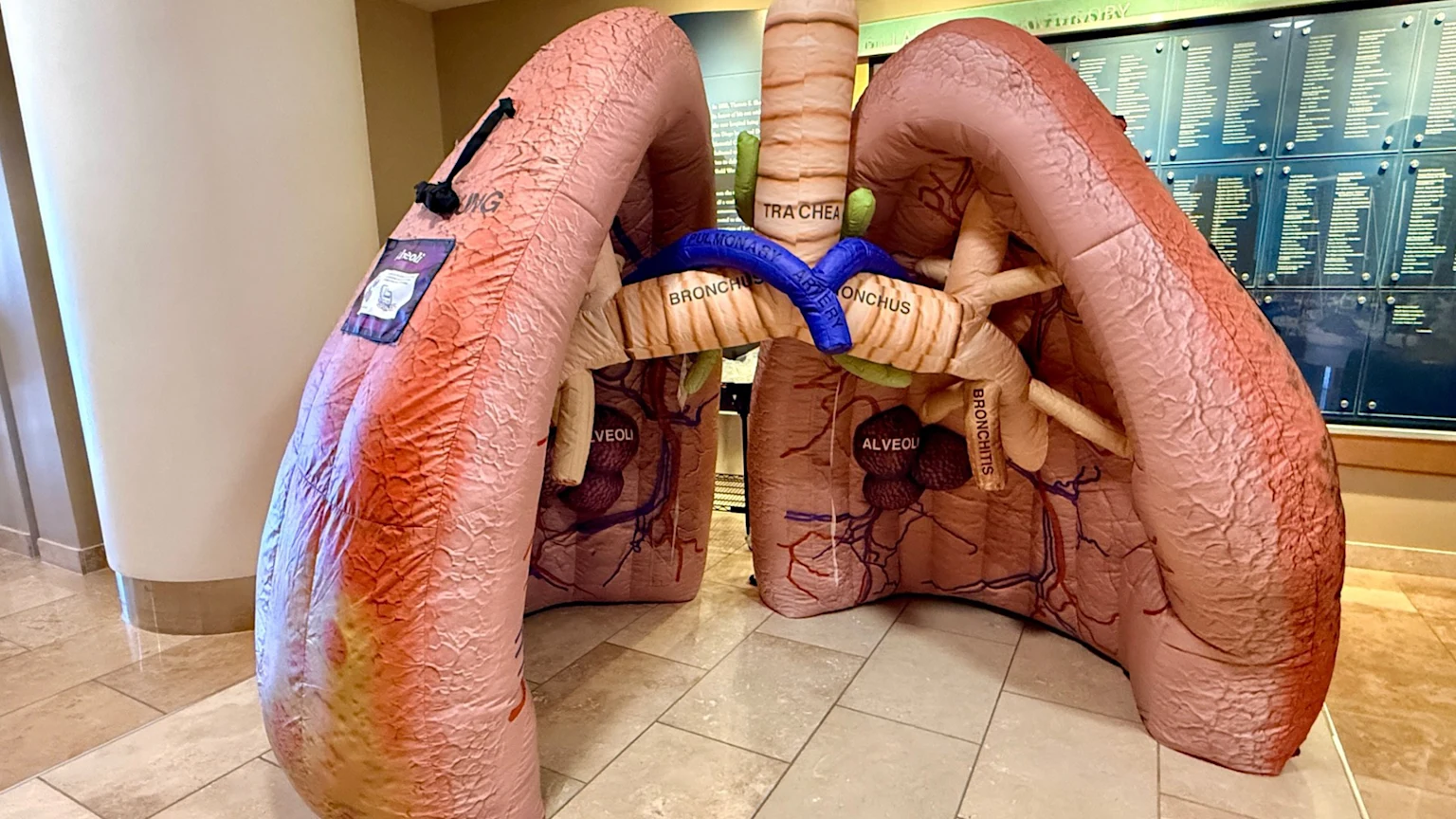
A set of inflatable lungs, provided by Genetech, at a lung cancer awareness event at Sharp Memorial Hospital on November 17, 2026.
How nodules are found
Lung nodules are typically discovered in two ways.
The first is as an incidental finding. A patient may come to the emergency room for an illness or injury, and a chest X-ray or CT scan detects an unrelated nodule.
The second is through low-dose CT screening, a quick, painless scan for people at higher risk of lung cancer, including smokers and former smokers. Of every 100 people screened, about 20 will have a nodule, and about 1 in 2 will be diagnosed with cancer and need treatment.
Technology catches nodules early
Whenever a radiologist reads an image at Sharp, artificial intelligence (AI) within the electronic health record helps flag possible lung nodules. Teams at the Burr Heart & Vascular Center at Sharp Grossmont, the Charney Heart and Lung Clinic at Sharp Memorial and Sharp Tri-City Medical Center are then notified.
The team contacts patients and encourages them to follow up with their primary care doctor. Low-risk nodules are monitored over time. If a nodule requires urgent attention, care is escalated quickly, and the patient can be referred to a pulmonologist, who determines whether additional procedures are needed.
“Finding a lung nodule can be concerning for patients,” says Dr. Mohammed Al-Janabi, an intensivist and pulmonologist with Sharp Community Medical Group and affiliated with Sharp Grossmont Hospital. “While most nodules are not cancerous, some may represent early-stage lung cancer. We use advanced technology, evidence-based care and a multidisciplinary approach to provide an accurate diagnosis, minimize unnecessary anxiety and ensure timely treatment when needed.”
If necessary, the team develops a treatment plan that may include biopsy, surgery to remove the nodule or cancer treatment at Sharp Cancer Institute.
“Before, we wouldn’t know of a patient’s lung cancer diagnosis until patients became symptomatic with more advanced cancer when a cure is harder to achieve,” says Grace Ullum, MSN, RN, director of heart, vascular and thoracic service lines at Sharp Memorial. “Now we can detect lung cancer much earlier, when survival odds are greater.”
According to Whitney Richey, manager of the Outpatient Pulmonary and Lung Nodule Clinic at Sharp Tri-City, a lung nodule finding can bring tremendous anxiety. She strongly believes every patient and their family deserve compassionate care and clear communication.
“I'm proud to be part of a health care system that prioritizes timely evaluation, care coordination and helping patients feel supported throughout their journey,” Richey says.
Less invasive robotic treatments
Robotic bronchoscopy allows doctors to guide a thin, flexible scope through the airways to reach small nodules deep within the lungs. Software maps the safest path using the patient’s CT scan, helping doctors diagnose and stage cancer sooner.
Sharp Grossmont, Sharp Memorial and Sharp Tri-City all offer Ion robotic bronchoscopy technology to help doctors biopsy small or hard-to-reach lung nodules. For patients who need surgery, Sharp Memorial also offers minimally invasive robotic lung procedures, which can result in shorter hospital stays.
Earlier detection, faster access
Over the past four years, robotic bronchoscopies at Sharp have detected more Stage 1 lung cancers, when treatment is most effective, than in the past. With Lung Nodule Program sites in Central San Diego, East County and North County, Sharp aims to improve access to timely care.
“We wanted more for our patients, and what sets us apart is access,” says Ullum. “With three sites, we can get patients in much sooner.”
Many patients in the program are current or former smokers, but smoking is not the only cause of lung cancer. Genetics can also play a role, which is why the program supports people whose nodules are found unexpectedly, even if they’ve never smoked.
In one case, a family member of a Sharp team member learned she had a cancerous nodule after an X-ray for an unrelated issue. She underwent surgery and, two years later, is doing well.
If you're concerned about your lung cancer risk, talk with your doctor about screening. If a nodule is found, a Sharp team will be ready to guide you through every step.

Grace Ullum is the director of the heart, vascular and thoracic service lines at Sharp Memorial Hospital.
Whitney Richey is the manager of the Outpatient Pulmonary and Lung Nodule Clinic at Sharp Tri-City Medical Center.

Our weekly email brings you the latest health tips, recipes and stories.

